


In pendulum practice, calibration means setting clear movement conventions and keeping the setup reasonably consistent. It does not turn a handheld pendulum into a validated instrument for finding unknown facts.
Use a comfortable grip, a clear viewing direction and separate outcomes for yes, no and unclear. Known-answer practice can help you recognise movement while leaving expectations and human influence visible.
A simple setup record
| Record | Example | Why it helps |
|---|---|---|
| Viewing direction | Facing the same labelled sheet | Toward/away and left/right stay clear |
| Grip and chain | Hold at the same comfortable point | Makes changes in handling easier to notice |
| Yes convention | Toward and away, if chosen | A personal label, not a universal code |
| No convention | Side to side, if chosen | Keeps the two labels distinct |
| Unclear outcome | Small, mixed or changing movement | Avoids forcing an unreadable response into yes or no |
Scroll sideways to see the full table.
What Makes a Pendulum Move?
A pendulum is a small weight suspended from a chain or a cord, and it can show tiny movements of the hand. These movements might happen without a conscious intention to make them happen. Expectation, attention, and the way you hold the pendulum can influence what you see.
research on the ideomotor effect in handheld pendulum tasks examines this connection between mental activity and small muscular movements. The paper concerns a defined laboratory task; it does not establish that a pendulum can answer arbitrary questions about health, relationships, or future events.
The ideomotor effect doesn’t mean that a person is pretending. A movement can feel as though it happened on its own yet still happened through bodily movements. This difference is useful because it allows honest curiosity without blaming the person using the pendulum.
You can attach spiritual meanings to the experience but keep the meanings separate from a claim that the movement is based on facts.
Picking a Simple Pendulum and a Comfortable Place
You don’t need an expensive crystal pendulum, or anything fancy to get started. A small weight attached securely to a chain or cord can work just fine. Pick something that feels comfortable in your hand and has enough weight to swing easily. Before using it, make sure everything is securely attached and that there aren’t any broken pieces or sharp edges that could hurt you.
Find a comfortable place where your pendulum has plenty of room to swing without hitting the table or anything around it. Try to stay away from fans, open windows, or other things that could create a draft and move the pendulum. It also helps to use a table or surface that isn’t being bumped or moved. Loose sleeves, bracelets, necklaces, and other nearby objects should be kept out of the way, so they don’t touch the chain while you’re practicing.
Sit in whatever position feels comfortable instead of worrying about holding yourself perfectly still. If your hand, wrist, or arm starts getting tired or hurting, give yourself a break. You don’t have to sit in an uncomfortable position to prove that you’re concentrating hard enough. Your posture can affect the way the pendulum moves, so if you change positions and notice that the swing changes too, keep that in mind before assuming the difference has a spiritual meaning.
If holding a pendulum is difficult because of limited mobility, you can adjust the way you practice or try a different spiritual or reflective exercise that works better for you. There’s no one movement your pendulum has to make, and being able to hold or move it a certain way doesn’t say anything about the strength of your psychic gifts or your spiritual connection. The practice should work with your abilities and feel comfortable for you, not become a test you have to pass.
Pendulum Setup in Five Steps: visual guide
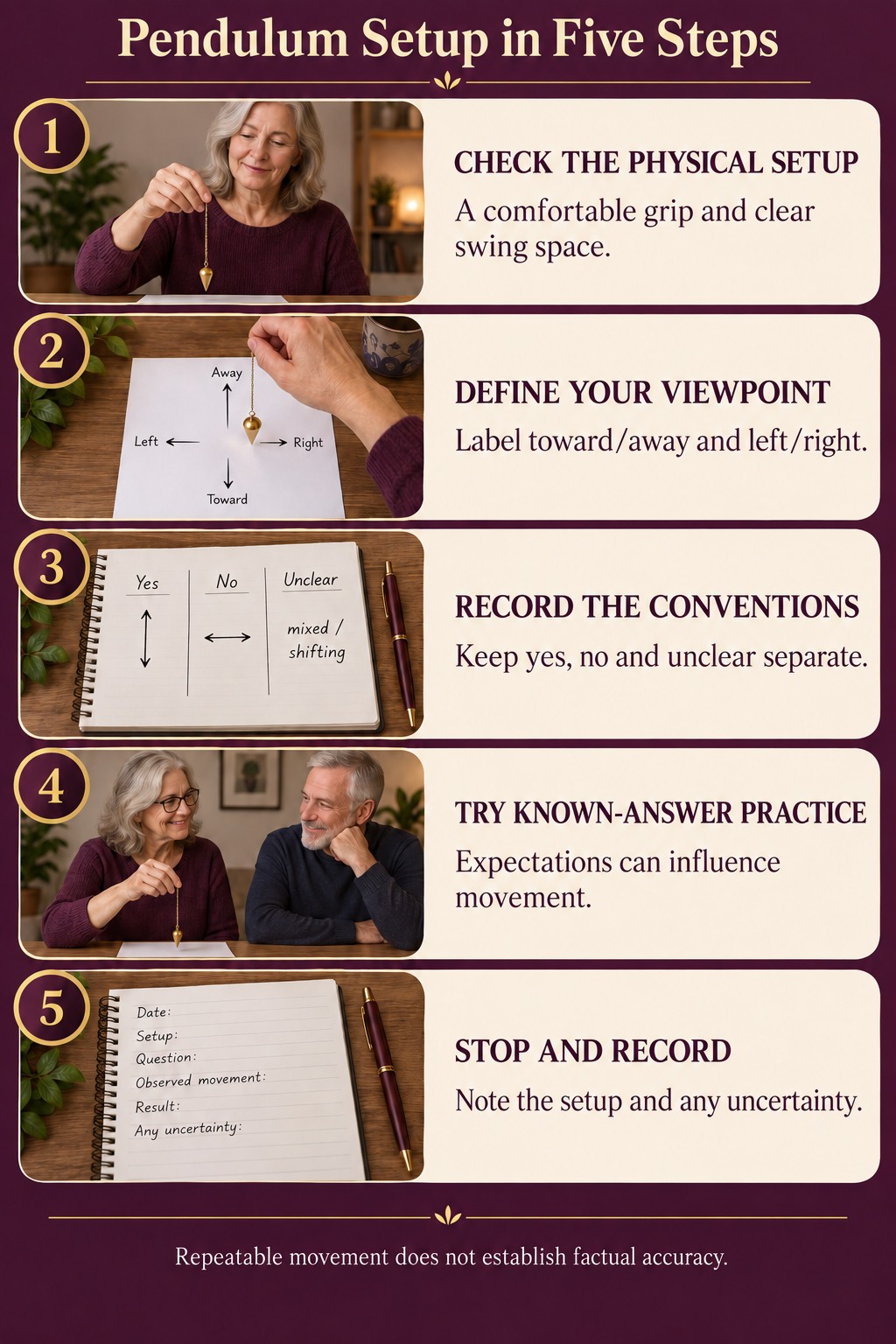
Read the infographic as text
- 1. CHECK THE PHYSICAL SETUP: A comfortable grip and clear swing space.
- 2. DEFINE YOUR VIEWPOINT: Label toward/away and left/right.
- 3. RECORD THE CONVENTIONS: Keep yes, no and unclear separate.
- 4. TRY KNOWN-ANSWER PRACTICE: Expectations can influence movement.
- 5. STOP AND RECORD: Note the setup and any uncertainty.
Looking at the Direction
Forward and back can mean different things depending on where you’re sitting. Before you assign answers, figure out how you’re going to describe the movement from your viewpoint. Write down a paper guide with labels for the directions toward and away from you, and for the directions to the left and right.
Circular motions also need to be clear. Clockwise and counterclockwise should be judged from the same viewing position every time. If you move the paper or change seats, you need to write the change instead of just assuming the meaning stayed the same.
Keep the guide easy. A chart with a lot of words on it can make it harder to decide what the pendulum is actually saying and easier to select a nearby answer as fact.
The purpose of the guide is to be consistent in your interpretations. Writing a symbol or a word under the pendulum doesn’t mean that the object detects truth from that word.
Assigning Responses
Practitioners often start by asking the pendulum to show a yes or no answer. You can use this as part of your ritual, but you need to recognize that the expectations can influence the motion. The observed direction is part of the reading and not proof of external intelligence.
You should choose the directions in advance. You might want to use forward and back for yes, for example, and side to side for no. There’s no universal direction every pendulum has to follow.
Keep unclear responses separate from yes and no. A shift, a small movement, or a mixed movement shouldn’t be a forced yes or no answer. If you can’t describe what happened with confidence, write it as unclear and then move on.
Write down the answers before you ask personally meaningful questions. Don’t reverse the labels partway through because one result is disappointing to you. Changing the rules after you see an answer makes the reading harder to interpret in an honest way.
Get Familiar with How Your Pendulum Moves
Before you start asking your pendulum questions, spend a little time getting familiar with how it moves. Try gently moving your hand in different directions and watch what the pendulum does. Notice how it swings, how the direction changes, and how the movement gradually slows down when you stop.
Next, hold the pendulum comfortably and try not to purposely move it in any particular direction. You might notice that it still begins to move slightly. That’s completely normal. Your hand and body are never perfectly still, so small movements can happen even when you aren’t intentionally creating them. You don’t have to treat every little movement as an answer. Right now, you’re simply learning what the pendulum’s movements look and feel like when you’re holding it.
Try to hold the pendulum in a similar way each time you practice. Keep the chain or cord around the same length and find a position that feels comfortable. Changing the length of the chain, the position of your hand, or even your posture can change the way the pendulum swings. Keeping things fairly consistent can make the movements easier to recognize, although it can’t completely remove the influence of the person holding it.
If the pendulum seems shaky or inconsistent at first, don’t immediately assume that your psychic gifts are blocked or that there’s negative energy around you. You also don’t need to rush out and pay someone for an expensive spiritual cleansing. Sometimes the simplest explanation is the right place to start. You’re holding a moving object with a human hand, and neither one is going to behave exactly the same way every single time.
Practice With Answers You Already Know
Once you’re comfortable with the movement, you can practice by asking a few simple questions that you already know the answers to. For example, you could place a red card in front of you and ask, “Is this card red?” You can also ask questions that should give you a “no” so that you aren’t practicing only one type of response.
This can help you become more familiar with the movements you’ve decided to use for “yes” and “no.” Just remember that getting the expected answer during this exercise doesn’t prove that the pendulum discovered the information on its own. You already know the answer, and your expectations can influence the small movements of your hand.
Pay attention to what the pendulum actually does instead of trying to make every movement fit into “yes” or “no.” If it starts moving diagonally, changes directions, or gives you a movement you can’t clearly recognize, it’s okay to write down “unclear.” You don’t need to change your interpretation afterward just because you were hoping for a certain answer.
You also don’t need to practice the same question over and over until the pendulum finally gives you the answer you expected. A few simple questions are enough to help you get familiar with your setup. Repeating a question until you get the movement you want can make it harder to tell if you’re observing the pendulum or slowly influencing it toward the answer you were already hoping to see.
Consistency and Correctness
Consistency means that a result or procedure can be repeated in a similar way. Correctness means that an answer matches the real facts. A method can be consistent and still be wrong, just as a clock can show the same incorrect time every day.
A stable yes direction tells you how you’re looking at the motion. It doesn’t tell you if a yes response to an unknown question is true or not. These are different questions that require different evidence.
The US Geological Survey's explanation of water dowsing discusses why apparent successes in locating hidden water do not by themselves demonstrate a reliable detection method. Although water dowsing is a different task from personal reflection, the distinction between a convincing experience and demonstrated accuracy is relevant.
Always use the same caution when you’re interpreting a result that feels important. A meaningful coincidence can be interesting without it being proof that every future answer needs to be trusted.
Looking at Accuracy
If you’re curious, you might compare guesses with a harmless hidden target under conditions where you can’t see it. A friend might prepare the target and keep the answer hidden, given that neither the behavior nor the setup gives clues during the response.
Decide the rules, including the number of attempts in the scoring, before you start. Write down every result, including misses and unclear responses. Don’t stop after the first lucky run or change the definition to make it successful after seeing the target.
Even then, a small home exercise doesn’t establish paranormal activity. Chance, subtle clues, or reading errors can affect the results. Treat this as an opportunity to pay attention to how easily a normal test can be biased.
Ordinary Readings
Pick a small number of low-stakes questions and then decide when the reading will end. Having clear limits helps stop uncertainty from turning into repeated checking. You don’t have to ask if you’re allowed to stop.
Write down the question before you pick up the pendulum. Use one subject and one idea, and don’t use wording that has several possibilities. An unclear question can make the answer hard to interpret, even if you have the right method.
If the movement still looks ambiguous, write down that there’s no readable response. You don’t have to keep asking in different words until one answer appears. You can go back to the issue through journaling or through ordinary information gathering.
After the reading, put the pendulum down and decide if it suggested anything useful that you could reflect on. Your next action should make sense on its own instead of depending entirely on the situation.
An Example of Making a Simple Adjustment
Nora notices that her pendulum seems to give her a different “yes” direction whenever she practices at her crowded kitchen table. At first, she starts wondering if she’s doing something wrong or losing her connection with the pendulum.
Before assuming that something spiritual has changed, Nora takes a closer look at how she’s using it. She realizes that she isn’t always holding the pendulum the same way. Sometimes the chain is longer, her hand is at a different angle, or she’s leaning against the table while someone else is moving around it.
Nora decides to try again in a quieter place. She keeps the chain about the same length each time, holds her hand in a comfortable position, and writes down which direction she considers “yes” and “no.” After making those small changes, the pendulum’s movements become easier for her to recognize and describe.
That doesn’t necessarily mean that her pendulum is suddenly giving her answers that are factually correct. It simply means she has created a more consistent way to practice. Nora can still enjoy using her pendulum for personal or spiritual reflection while checking important factual questions in other ways.
Her experience is also a good reminder not to immediately assume that every unexpected pendulum movement has a deeper spiritual meaning. Sometimes something is as simple as the way you’re holding it, the surface you’re sitting near, or movement around you can affect what you see. Checking those simple things first can keep a small change from turning into something much more frightening than it needs to be.
Know When You Need More Than a Pendulum
There are some questions that a pendulum simply shouldn’t be responsible for answering. It shouldn’t be used to diagnose an illness, decide which medication you should take, identify an allergy, tell you if something is safe to eat or use, or decide if someone is in danger. Those situations need reliable information and, when appropriate, help from a qualified professional.
The same thing applies when you’re asking questions about another person. A pendulum can’t confirm someone else’s private thoughts, feelings, or consent. Getting a “yes” from your pendulum doesn’t override another person saying no or asking you not to contact them. It also isn’t evidence that someone is lying, cheating, hiding something, or doing something else you might be worried about.
When you need a factual answer, start with the source that can actually give you that information. You might need to ask the person directly, read an agreement, talk with a professional, or look at what’s actually happening. If you still want to use your pendulum afterward as part of your spiritual practice, you can. Just keep that reflection separate from the facts you need to make the decision.
You can enjoy using a pendulum without expecting it to answer every kind of question. In fact, giving it some limits can make the practice more enjoyable. It can remain something meaningful for reflection and spiritual exploration without having to carry the responsibility for decisions that need more reliable information.
Setup Vs. Interpretation
Write a two-column note to make your practice easier to understand.
Write down what you observed, such as that your elbow was supported and the chain was held at the same point.
Write down what you interpreted, such as that you assigned a circle to yes.
These differences are useful when you want to change something. If you change the pendulum’s weight, chain length or handling, its movement may change. The observation can work with the object’s physical properties, but it doesn’t mean that a new object is less spiritual or that your past answer needs to be withdrawn.
A friend might assign a different movement to yes, for example, and you don’t have to look at the two conventions as if they have a universal code. These are separate and personal arrangements. Keeping the details seen allows you to talk about the reading accurately without making the meaning bigger than the observation allows. It also makes it easier to stop if the movement is hard to understand and to keep honest records that the response was unclear.
Final Thoughts: Keeping Brief Records
Note the setup, response, question, moment, and any uncertainty. This is enough to help you see if changes in handling or wording affected the reading. A detailed score for every daily choice you make isn’t necessary.
Look at what you wrote here and there instead of after every uncomfortable feeling you have. If you’re using a pendulum repeatedly and it makes you feel more worried or makes making decisions harder, take time to pause and then get support for your underlying distress.
You don’t have to have a final answer before you put the object away. Ending an unhelpful reading is your own choice to make. No movement has the authority to make you participate.
Pendulum calibration is helpful when it’s understood as setting clear conventions, keeping conditions consistent, and acknowledging unclear results. These kinds of habits make the practice easier to understand while leaving truth, safety, and important decisions with appropriate evidence.
Once your setup is clear, see how to word pendulum questions.
For the next step, explore choosing a pendulum.
Frequently asked questions
1. What does pendulum calibration mean here?
It means setting movement conventions and a reasonably consistent physical setup. It is not calibration of a scientifically validated detector of truth.
2. Do I need a crystal pendulum?
No. A securely attached small weight can show movement. Comfort, intact components and safe handling matter more than elaborate materials.
3. What can make a handheld pendulum move?
Small hand movements, including movements made without deliberate intention, can affect it. Drafts, contact and handling can also influence the swing.
4. Is there one universal yes direction?
No. Practitioners use different conventions. Write down the direction you choose rather than treating it as a code every pendulum must follow.
5. How should I describe directions?
Use a consistent viewpoint and labels such as toward/away or left/right. Record changes in seating or the guide’s orientation.
6. How long should the chain be?
Choose a comfortable length with enough clear swing space, then keep the hold point consistent. No particular length certifies accuracy.
7. Should I force my hand to remain perfectly still?
Use a comfortable position instead. Your body is not perfectly motionless, and discomfort can add strain without making the exercise a truth test.
8. Can I support my elbow?
If comfortable, you can use support and record it as part of the setup. A change in support may affect handling and movement.
9. Why practise with answers I already know?
It can familiarise you with the observed movements and labels. Because you know the answer, expectation can influence the response; it does not demonstrate independent detection.
10. Should I practise both yes and no?
If learning the conventions, include both rather than observing only one label. Keep unclear movements as a separate result.
11. What counts as unclear?
Movement you cannot confidently describe under your rule, such as a shifting or mixed swing. Do not force it into a yes or no.
12. Why do directions change between sessions?
Check grip, posture, chain length, viewing position and nearby movement first. A change does not by itself establish a spiritual block.
13. Does repeated agreement prove accuracy?
No. A response can repeat while remaining wrong. Consistency and correspondence with real facts are separate questions.
14. Can I use the pendulum for health or safety decisions?
Do not give it that responsibility. Use reliable information and appropriate qualified support for questions about health, hazards or other significant decisions.
15. What should I record after practice?
Note the question, setup, observed movement, assigned label and uncertainty. A brief honest record is enough; every daily choice need not become a session.