


A clearer pendulum question has one subject, understandable terms and a purpose that fits low-stakes reflection. Better wording reduces ambiguity; it does not make the movement an independent source of facts.
Write the question before picking up the pendulum. If the answer requires another person, a document or a qualified professional, use that source. Some questions become clearer through journaling instead of a yes-or-no reading.
Rewrite the question—or choose a better format
| Original wording | Problem | Useful alternative |
|---|---|---|
| Do I want to read and walk tonight? | Two activities in one answer | Consider each harmless activity separately |
| Is this course good for me? | Good is undefined | Compare schedule, cost, subject and access directly |
| Will moving make me happy? | A complex future outcome | Journal what you hope to change, then research the practical factors |
| Has my ex realised we belong together? | Assumes destiny and private knowledge | Reflect on your own hopes while respecting their stated boundaries |
| Is it not wrong not to reply? | Several negatives | Clarify the actual choice in ordinary language |
Scroll sideways to see the full table.
Remember How You Use the Words
A pendulum can magnify small movements that happen without a person consciously meaning to move. research on the ideomotor effect in pendulum tasks examines how mental activity and bodily movement can be connected. A carefully phrased sentence does not eliminate expectation or turn the pendulum into an independent source of information.
This matters because a question can have an answer you want to receive, such as “Is this a good opportunity for me?” This already describes the opportunity in a positive way and invites you to try to get a yes for this story.
You don’t have to accuse yourself of faking the movements but recognize that attention and expectations are part of the setup. Being aware of this helps you keep the interpretation honest.
If you want to look at a factual claim, use a method that is suited to the facts. Make sure your wording is useful and that the questions you ask are good but know that it doesn’t mean it’s a tool for reliability.
Decide What You Want from the Question First
Before you start asking your pendulum questions, think about what you’re actually hoping to get from the practice. Maybe you’re trying to figure out which of two simple options you prefer, practicing what your “yes” and “no” movements look like, or looking for reassurance because you’re unsure about something. Knowing what you’re hoping to accomplish can help you decide if using your pendulum makes sense for that particular question.
For simple, low-stakes decisions, the most useful part might actually be noticing how you feel about the answer. Imagine that you’re deciding between two harmless options and your pendulum gives you one of them. If your first reaction is disappointment because you were secretly hoping for the other one, you’ve probably learned something important about what you really wanted. That doesn’t mean the pendulum proved which option was better. Your reaction simply helped you recognize a preference you might not have noticed before.
Some questions need more than a pendulum. If you’re trying to find out if you’re sick, if someone is in danger, what will happen with your money, or what another person is secretly thinking or feeling, look for information that can actually answer the question. Depending on the situation, that might mean talking with the person directly, checking the facts, or getting help from a qualified professional.
You can also decide that something feels too important or emotional to ask about right now. There’s nothing wrong with putting your pendulum away and coming back to your spiritual practice another time. You don’t need a sign telling you that you’re allowed to stop.
Write a Clear Pendulum Question: visual guide
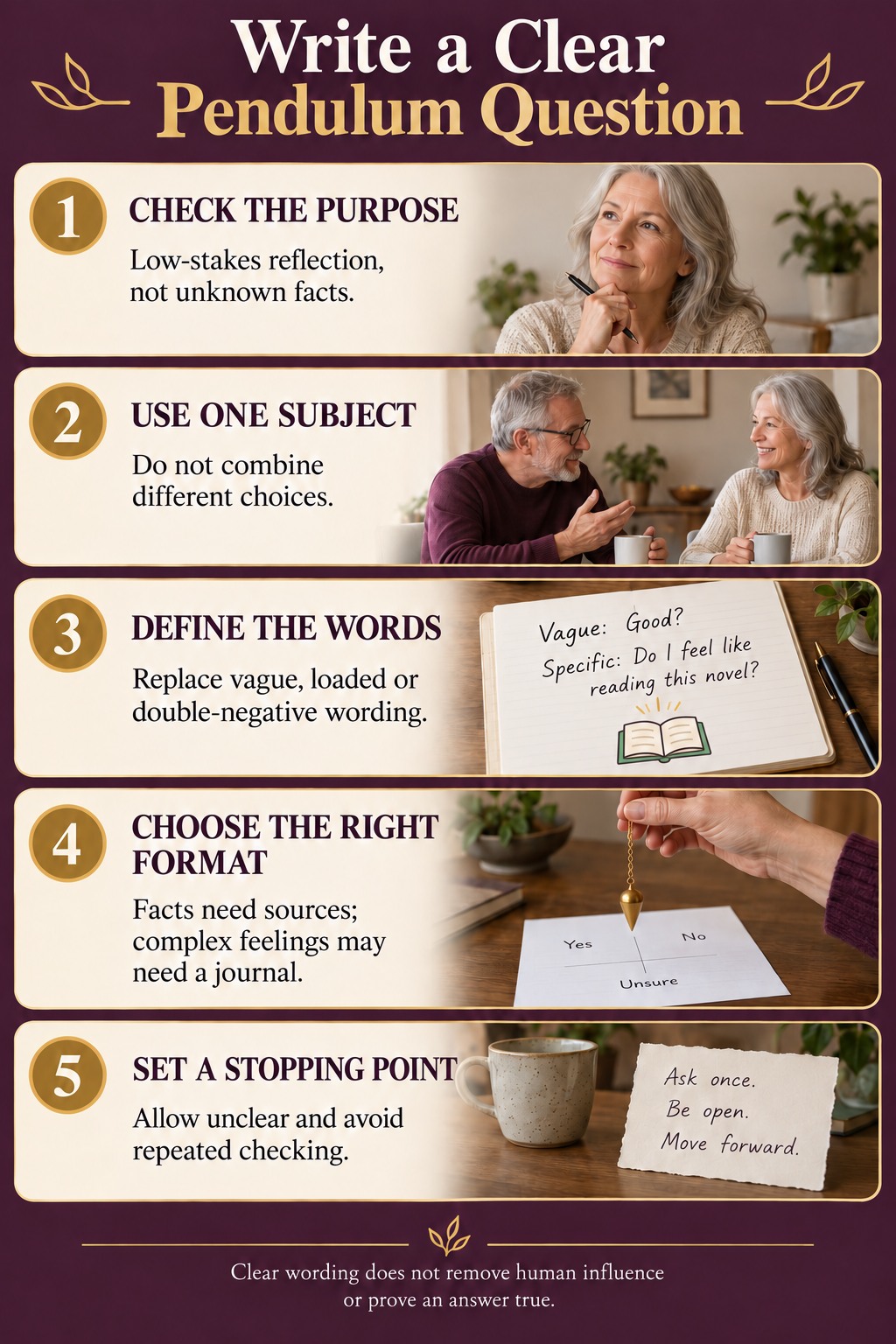
Read the infographic as text
- 1. CHECK THE PURPOSE: Low-stakes reflection, not unknown facts.
- 2. USE ONE SUBJECT: Do not combine different choices.
- 3. DEFINE THE WORDS: Replace vague, loaded or double-negative wording.
- 4. CHOOSE THE RIGHT FORMAT: Facts need sources; complex feelings may need a journal.
- 5. SET A STOPPING POINT: Allow unclear and avoid repeated checking.
Ask About One Thing at a Time
Try to keep each question focused on one thing. For example, asking, “Should I accept this job and move closer to my partner?” actually contains two major decisions. If the pendulum swings “yes,” you still won’t know if that response relates to taking the job, moving, or doing both.
Instead, look at each part of the decision separately. You might first need to learn more about the job, such as the pay, schedule, responsibilities, and opportunities. Then you can think about the move and what living closer to your partner would mean for you. Some questions also need more information before you’re ready to make any kind of decision.
The same idea can apply to something much smaller. Asking, “Would I enjoy reading and taking a walk tonight?” still combines two different activities. If you’re simply using your pendulum to explore what you feel like doing, consider each activity separately. You might even realize that you don’t need the pendulum because thinking about each option has already helped you figure out what sounds better.
Keeping questions simple doesn’t mean you need to ask your pendulum about every tiny decision you make. The practice should stay enjoyable and useful instead of turning into constant checking. Asking question after question about every little detail can leave you feeling more confused instead of giving you more clarity.
Don’t Use Vague Words
Words such as “good,” “right,” and “ready” can have different meanings. Before you use them, ask what words you recognize in real life. This question depends on undefined terms, and it’s hard to interpret consistently. Instead of asking if a course is good for you, for example, figure out the features that matter, such as:
- schedule
- cost
- subject
- accessibility
- the kind of learning you want
These are features that can be checked often and directly. If you still want to ask a reflective question, keep it connected to your experience. Do you notice an interest in a subject when you see an advertisement? You can look at this through writing or through your own reflection without a pendulum. Specific language doesn’t mean artificial precision. You don’t have to add an exact date or number just because a prediction sounds testable when the tool can’t tell you the outcome in the first place.
Getting Rid of Conclusions
Don’t ask questions that assume things. Asking something like “Is my coworker jealous of my success?” assumes that jealousy is an explanation of the interpretation. A pendulum response can’t verify someone else’s mental state.
Go back to the event that you saw. Maybe the coworker didn’t respond to the message. You can pay attention to the observation without giving it a motive. The best question might be whether there’s a communication issue that needs to be addressed.
At the same time, saying something like “Has my ex finally realized that we belong together?” assumes that having a shared destiny exists. This isn’t made safer just because you change a few words. The same request needs to be reconsidered completely.
If you want to reflect, ask what you hope the answer would give you. You might want reassurance, closure, or permission to move forward. These are things that you need to talk about without claiming to know someone else’s thoughts.
Keep Your Questions Simple and Clear
Try to avoid questions with several negatives in them. Something like, “Is it not wrong for me not to reply?” can get confusing really fast. If the pendulum gives you a “yes,” you might not even be sure what you think that answer means. This can become even more confusing if you’re already emotional about the situation.
It also helps to avoid questions that make it seem like you only have two extreme choices. For example, “Should I stay forever or leave tonight?” leaves out all kinds of possibilities in between. You might need more information, want to talk with someone you trust, set a boundary, or simply give yourself more time before deciding what you want to do.
For bigger decisions, the solution isn’t always finding a better way to turn the situation into a yes-or-no pendulum question. Some decisions are too complicated for that. Look at the actual choices you have, gather the information you need, and get appropriate advice when it could help.
For simple practice questions, keep the wording short and focus on one thing at a time. Try reading your question out loud before you begin. If you aren’t completely sure what a “yes” would mean, rewrite the question or consider if it’s something you really need to ask your pendulum.
Be Careful About Questions Involving Other People
A pendulum can’t reliably tell you if another person loves you, is cheating, has a particular mental health condition, or wants you to contact them. Those questions involve someone else’s private thoughts, feelings, health, or decisions, and a pendulum movement can’t confirm them for you.
Instead, focus on the information you actually have. Think about what the person has told you, what the two of you have agreed on, and what you’ve personally observed. From there, you can decide what you want, what questions you need to ask directly, and what you’re comfortable participating in.
Love is respect’s boundaries guide explains that healthy boundaries involve understanding and respecting each person’s needs and limits. That still applies when spiritual practices are part of your life. A pendulum shouldn’t be used as a way around someone else’s boundary or as a replacement for asking a question that needs to be answered by the person themselves.
If someone has already asked you not to contact them, a “yes” from your pendulum doesn’t change what they told you. You can still use your spiritual practice privately to explore your own feelings about the situation, but you should respect the boundary they’ve already made clear.
Preferences Vs. Predictions
If you ask, “Do I feel drawn to this activity?” it shows your present experience. If you say, “Will this activity change my life?” this asks for a future outcome that can’t be established by a reading. The two questions might feel related, but they have different expectations.
Even a present preference doesn’t have to be outsourced. Pay attention to your reaction before and after the movement. You might find that you already have the view you were looking for and give yourself permission to trust it.
For normal exercise, pick two options, such as which novel to start. Write your own preferences privately first and then pay attention to whether the pendulum results change how you feel. Treat the exercise as a reflection of your reaction, not a test of your destiny.
Don’t use the same approach for medicines, food safety, big spending, or risky travel. The stakes change when a responsible decision is needed.
Unclear Responses
For the reading, define what you’re going to do if the movement is small, shifting, or unreadable. The best rule is to write “unclear” and stop trying to interpret the question.
An unclear result doesn’t prove a spiritual block, a hidden danger, or a need to rephrase the question until you get an answer. It might reflect ordinary variations in the movement or indicate that you have a hard time with the exercise.
Keep uncertainty as an outcome. You can write “The session didn’t help me understand the issue at all” and then move on. The practice is hard to evaluate when you have to have a meaningful answer each time.
Rewriting the Question
If you ask a question, “Will I be happy if I move?” look at the complexity of the question. Happiness might involve housing, work, relationships, health, and finances. The best next step is to look at those areas and not to try to find a yes-or-no formulation.
If you’re reflecting, you might try writing, “What do I hope that the move will change?” This is an open-ended question that you can write in your journal instead of a pendulum question that is a yes-or-no. Choosing a better format is part of understanding the problem.
Another question, such as “Should I message that person again?” requires more context. If the contact is unwelcome, the boundary already gives you an answer. If the contact is welcome, think about what you want to say and whether the message will give you a reasonable purpose.
The lesson isn’t that every question has to work for pendulum use. Some are clear when you stop asking the pendulum for answers.
Set an Ending
Pick a small number of questions in a short period for the reading and decide that you won’t repeat a question just because the answer disappoints you. Write the rules before you hold the pendulum so it doesn’t change the response to the results. If you feel like you should keep asking, set the object down and go back to a regular task or talk to someone you trust.
You don’t have to have a final yes to confirm that you might need to stop for a while. The NHS discussion of reframing unhelpful thoughts offers a different way to examine an assumption: consider evidence and a more balanced perspective. That can be more useful than repeatedly requesting reassurance from a symbolic tool.
If the patterns disrupt your life or it feels hard to control them, talk to qualified support. You can talk about distress and keep a good relationship with your spiritual interest.
Review Your Question and Responses
After a reading, keep a record of the exact wording, the movement you saw, and the meaning you assigned to it. Separate these things later so interpretation doesn’t get confused with what happened.
Note your emotional reaction. Did you feel relief, disappointment, pressure, or no clearer than you did before? Your reaction might help you understand what you wanted from the exercise without proving that the answer was true.
Don’t collect just successes. If you choose to look at the outcomes, include misses, unsure results, and questions that were too vague to look at. A selective memory can make a method look more reliable than the record shows.
You don’t have to turn the practice into a research project. A short and honest note is enough to keep your own interpretations visible and to see when the activity is no longer useful.
Read the Question without the Pendulum
Before you start, say the question out loud and imagine explaining it to a friend. Would they understand what you meant if you said words like “ready,” “soon,” “better,” or “right”? If these words have different meanings, then figure out what the meanings are first.
You might find that writing the question has already clarified your preferences. Maybe you want more time, a smaller commitment, or information that you’ve not requested yet. This is a good outcome on its own. You can pick an ordinary next step without completing a pendulum reading or getting a symbolic confirmation.
Final Thoughts: Use Clear Wording
Good questions are specific, understandable, and appropriate to the method you’re using. When doing pendulum work, this means keeping the exercise low-stakes, acknowledging human influence, and then allowing no readable answer.
The best result might be finding out that the question belongs somewhere else. A direct conversation can give a preference, and an expert can explain a technical issue. A written comparison can show your own priorities.
You can enjoy a pendulum as part of your personal reflection rituals without making it part of your truth or safety. Ask the questions carefully and pay attention to what the reading brings up. Keep your final choices within your own judgment.
For setup and response conventions, begin with how to calibrate a pendulum.
For the next step, explore emotional decompression.
Frequently asked questions
1. What makes a pendulum question clear?
It has one subject, defined terms and an appropriate low-stakes purpose. You should understand what yes, no and unclear would mean before beginning.
2. Does precise wording guarantee a true answer?
No. Clear language helps you understand the question; it does not remove expectation or make the pendulum a reliable source of unknown information.
3. Why avoid two questions in one?
A single movement does not tell you which part it supposedly answers. Separate the issues and consider whether either needs factual information instead.
4. What is a harmless practice example?
You might reflect on which novel you feel like starting. Notice your own reaction to the result rather than treating it as proof that one book is objectively better.
5. What is wrong with the word good?
It can mean affordable, enjoyable, accessible or useful. Name the features that matter and check them directly.
6. Should I add an exact date to every question?
No. Artificial precision does not make an unsuitable prediction reliable. First ask whether the method can establish the requested information at all.
7. What is a loaded question?
It builds an assumption into the wording, such as that a coworker is jealous. A pendulum cannot verify that private motive.
8. Why avoid multiple negatives?
They make a yes or no difficult to interpret. Rewrite the choice in ordinary positive language or use another format.
9. Can I ask what someone secretly feels?
A movement cannot establish another person’s private thoughts or consent. Use their words and behaviour and ask directly when appropriate.
10. Can a yes override a no-contact boundary?
No. Respect the person’s stated boundary regardless of a symbolic response.
11. How are preferences different from predictions?
A preference concerns your present reaction. A prediction claims a future outcome. Notice the reaction without turning it into verified knowledge.
12. When is journaling a better choice?
Use it for open-ended questions such as what you hope a move would change. Complex feelings need not be forced into yes or no.
13. What should I do with an unclear movement?
Record unclear and stop interpreting that response. It does not establish a hidden danger or require repeated rephrasing.
14. How many times should I repeat a question?
Do not keep repeating it until the preferred answer appears. Set your limit beforehand and pause when more checking adds no useful information.
15. What belongs in the session note?
Record the exact wording, observed movement, assigned meaning and your reaction. Keep those separate so an interpretation is not mistaken for a fact.