

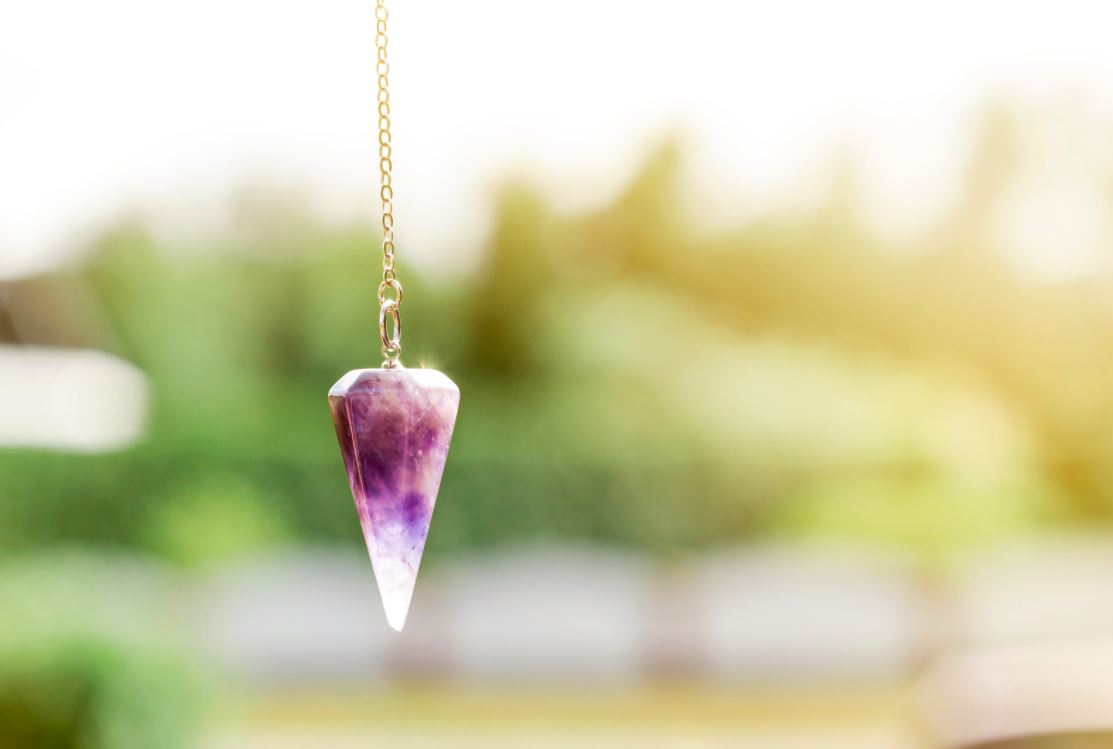
A gemstone pendulum can be a symbolic object in a personal ritual. Some people combine it with ideas about Feng Shui when reflecting on how they use a room. The useful outcome may be recognising what you want from the space and choosing a small practical change.
You may describe your aim as wanting to get rid of negative energy. Add an ordinary description of the change you want: a chair you can use, a clearer work surface or fewer interruptions.
A movement does not diagnose a problem in your home or establish a gemstone’s healing properties. Keep your personal associations, ordinary observations and factual concerns separate as you explore the practice.
Give the gemstone a personal meaning
You may like an object because of its colour, a memory or the way it feels to hold. If you associate it with rest, focus or welcome, write that down as your own association. Different people can choose different meanings.
You do not need a prescribed stone for each room, and an unfamiliar name does not make a crystal more powerful. Ask what the object is actually made from if that matters to your choice. A seller’s description of symbolism does not demonstrate that the item treats a health condition or changes another person’s feelings.
Likewise, a beautiful object can be meaningful without a story about an ancient date or a universal tradition. Use an association you can explain instead of relying on a claim you cannot check.
1. Choose one ordinary purpose for the room
Start with an activity: reading in a corner, finding your work materials, greeting visitors or having a quieter place to sit. A purpose like this gives you something you can observe afterward.
Instead of asking whether a room has bad energy, ask what is making the activity difficult. You might notice a crowded surface, uncomfortable seating, glare or frequent interruptions. You can address those things directly without asking the pendulum for permission.
2. Describe the space before interpreting it
Ordinary observation
“Mail covers the chair where I want to read.” This describes something you can inspect and change.
Personal meaning
“I want this corner to feel welcoming.” This describes a preference you can explore; it is not a measurement of an invisible force.
If you choose a Feng Shui interpretation, record the approach you are using and what the symbol means to you. Do not treat every personal crystal association as a rule that everyone must follow. You can enjoy an arrangement and still explain its practical purpose in everyday language.
3. Keep any pendulum exercise optional and brief
Check that the weight is securely attached and comfortable to hold. Leave space for movement and keep the chain clear of clothing or nearby objects. You may want to use the pendulum setup guide to describe directions and response conventions consistently.
A low-stakes prompt might concern your own preference, such as whether you feel like making time to read this evening. Notice your reaction, including if the movement leaves you no clearer. You can put the object down and choose what you want without completing a reading.
Write “unclear” for a movement you cannot describe confidently. A fast swing, a still object or a change of direction does not establish that your room is harmful or that someone has sent you a message. Repeating a question until a preferred answer appears makes the record less useful.
4. Make a practical change and review that change
Choose one manageable action connected to your original purpose. Clear the reading chair, give frequently used items a place or adjust the arrangement so the activity is easier. Start with what you already have rather than assuming you need another crystal.
Later, ask whether the change helped the activity. Is the chair available when you want to read? Can you find your materials? These observations can help you decide what to keep. They do not prove that a gemstone changed a hidden energy grid.
Example: making a reading corner usable
In this hypothetical example, Jordan wants to use a corner for reading. They choose a familiar stone as a reminder of that intention. The pendulum movement is unclear, so they record it that way. They still move the mail off the chair and adjust a lamp because glare was distracting. The next evening, they check whether the corner is easier to use. Their practical decisions do not depend on interpreting a swing as a diagnosis.
A five-line room reflection note
- Room and purpose: What activity do I want to make easier here?
- Observation: What can I actually see, hear or describe?
- Personal association: What does the object or arrangement mean to me, if anything?
- Chosen change: What small action will I take for an ordinary reason?
- Review: Did that change help the activity, and what remains unresolved?
You can leave the symbolic part blank. The note has no energy score, diagnostic result or required purchase.
Keep technical and health questions with suitable evidence
Electric and magnetic fields are physical phenomena. The NIEHS overview of electric and magnetic fields describes different categories and research contexts. A pendulum response is not a measurement of an exposure, and a spiritual interpretation should not be presented as such a measurement.
A list of symptoms does not establish that an unseen grid caused them. If you have a health concern, seek appropriate health care. If you suspect an actual problem with equipment or the home, use a suitable technical assessment. A gemstone arrangement does not establish the cause or repair the problem.
NCCIH’s guidance on complementary health approaches explains why unproven practices should not replace or delay established care.
Keep the parts that help you reflect
You may enjoy the appearance of a stone, the intention behind an arrangement or a quiet pause in the room. Those preferences can stand on their own. You do not need to claim a cure, a guaranteed change in fortune or a verified prediction to keep a meaningful personal ritual.
If the practice makes the room feel more frightening or leaves you repeatedly checking for danger, set the object aside. Return to what you can observe and the practical reason you chose the space. You can change or stop the exercise whenever you want.
Frequently asked questions
1. Do I need a particular gemstone for a room?
You can choose an object for your own preferences and associations. No required stone or universal room assignment is established by a pendulum response.
2. Does a fast swing show harmful energy?
A fast swing does not establish that a room contains a harmful force. Check ordinary conditions affecting the movement and record what you observed without assigning a diagnosis.
3. Can a pendulum check EMF levels?
A pendulum response is not an exposure measurement. Use an appropriate technical source or assessment for a factual concern about electric or magnetic fields.
4. Should I buy another crystal if a room feels wrong?
Start by describing the concern and any practical change you can make. An uneasy feeling does not by itself show that a purchase or cleansing is needed.
5. What if the exercise makes me more worried?
Put the object down and return to ordinary observations or another activity. You can stop without a final answer. Seek trusted or qualified support if the distress continues.
Does anyone have recommendations for a beginner’s guide to using gemstone pendulums?
There are quite a few good books on the subject. You might want to check online retailers for reviews.
YouTube tutorials can also be really helpful for beginners.
I’m curious about using a pendulum for personal chi. I might give it a try.
It’s good to know which gemstones to use in different rooms for optimal Feng shui.
I have a hematite pendulum and it really does help me stay calm.
Can anyone share where to buy a high-quality gemstone pendulum?
The historical background for each gemstone is fascinating.
Yes, it’s amazing how these stones have been used for thousands of years.
I didn’t know that pendulums could help with dowsing and detecting hidden energies in the home.
This is an interesting take on using gemstone pendulums for Feng shui.
I agree! I didn’t realize there were so many uses for different gemstones.