

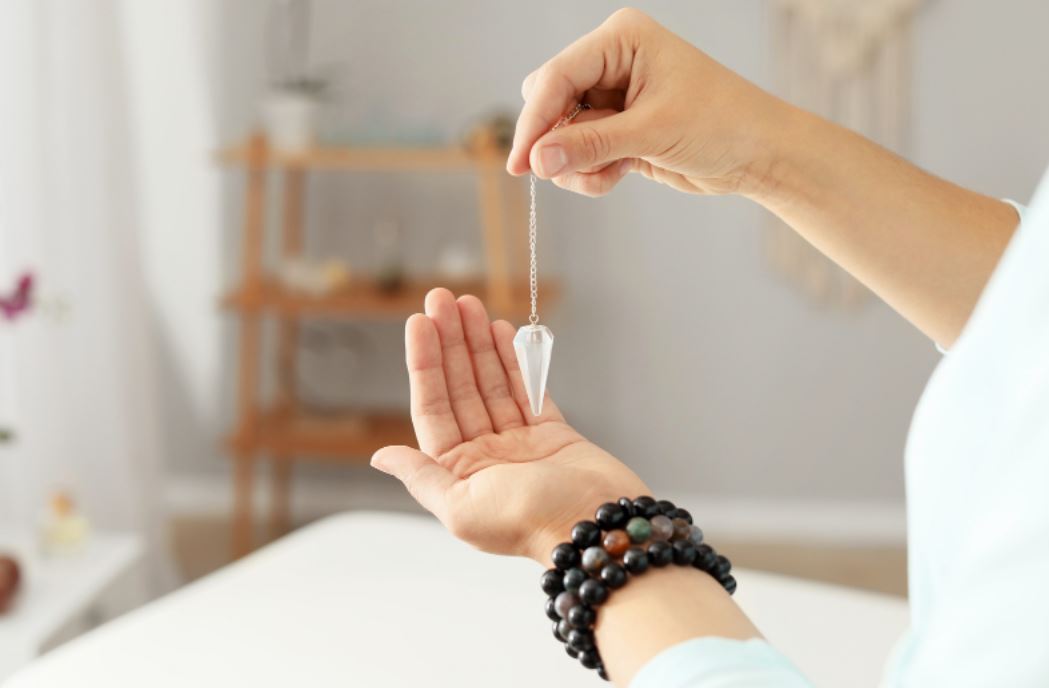
To begin using a pendulum, let a small suspended object hang freely, support your arm comfortably and notice how it moves. You can then choose movement labels for a personal reflection exercise. Keep the movement you see separate from the meaning you assign to it: a swing is an observation, while “yes” or “no” is an interpretation.
For your first practice: use one comfortable pendulum, a clear space and a notebook. Start with holding and observing it. You do not need a special crystal, a board, a ritual or a question about your future.
If a response stays unclear, write “unclear” and finish. Getting a definite answer is not a requirement for a useful first session.
What makes a pendulum move?
A pendulum is a weight hanging from a chain or cord. Small movements of the supporting hand can start or sustain its motion, including movements you do not deliberately notice. This is commonly discussed as the ideomotor effect. A laboratory study of pendulum responses examined ideomotor movement in a visual task; it did not establish that pendulums can reveal private thoughts, diagnose illness or predict events.
You may still give the practice personal or spiritual meaning. The practical distinction is between using an object to notice your own reactions and treating its motion as independent evidence about the world.
Five steps for a first pendulum session
1. Choose a comfortable object and place
Use a pendulum you can hold without strain. A simple, securely attached object is enough; there is no required gemstone or universal weight that makes answers true. Check that the cord or chain is intact and the weight will not strike a fragile surface.
Sit where your arm can rest and where moving air, a fan, a bumped table or a pet is less likely to interfere. You do not need to make the room perfectly still or spiritually “clean.” For help comparing practical features, see choosing a pendulum you can handle comfortably.
2. Let the pendulum hang freely
Hold the top of the chain or cord gently between your fingers. Support your forearm or elbow if that feels comfortable. Leave enough space beneath the weight for it to swing without touching your hand, the table or a board.
Adjust your grip and the hanging length for comfort rather than following a supposedly lucky measurement. If your hand shakes or your shoulder tightens, set the object down and change position. You can also leave the exercise for another time.
3. Observe movement before naming an answer
Notice what happens without asking a question. Does the weight move in a line, turn in a circle, drift or stay nearly still? Describe what you can see in ordinary words. Your first entry might be “small side-to-side movement,” rather than “the pendulum agrees.”
Try allowing it to settle, then make a small intentional hand movement and observe the result. This shows how readily a physical change can affect the swing. It is an observation exercise, not a test of an unseen ability.
4. Use a simple convention, with room for uncertainty
If you want to use yes/no labels, write down your convention before interpreting a response. You might label one visible direction “yes,” another “no,” and movement you cannot distinguish “unclear.” No direction has a universal meaning.
Some people ask the pendulum to show each label instead. Whichever approach you choose, record the observed motion as well as the label. Answering a fact you already know can help you practise describing motion; it does not establish that a later answer about an unknown fact will be accurate. A more detailed calibration guide explains the difference between a repeatable convention and a verified answer.
5. Try one small reflection and finish with a real action
Choose a low-stakes preference that belongs to you, such as whether you would like to spend a few minutes sketching this evening. Note the exact question, observe the motion once and write how you feel about your interpretation. You may agree, disagree or decide the exercise added nothing.
Your next step can be ordinary and reversible: put a sketchbook on the table, check how much free time you have, or choose to rest. Set a stopping point before you begin. Repeating the question until a preferred response appears does not provide independent confirmation.
A setup record you can copy
Keep physical observations separate from meaning
- Setup: Where was your arm supported? Was the chain hanging freely? Was there nearby movement or airflow?
- Observation: Describe the direction and size of the motion, or write “nearly still” or “unclear.”
- Interpretation: If you used a label, record it as a label rather than a fact.
- Your response: What did you notice about your own preference or feeling?
- Next step: Name one practical action, a source of information to check, or a decision to stop.
Example: “Forearm on the table; no contact beneath the weight. Small diagonal movement, unclear under my convention. I felt relieved at the idea of a quiet evening. I will check tomorrow’s commitments and decide how to spend tonight.”
You do not need to keep a score, calculate a success percentage or turn every daily choice into a session. The record is useful when it helps you distinguish what happened from what you hoped it meant.
When the movement is hard to read
The pendulum stays still
Check whether the weight is touching something or the chain is caught. Adjust an uncomfortable grip, or stop. Stillness does not establish a spiritual block or a failure to believe strongly enough.
The direction changes
Notice changes in your hand, posture, viewing position or surroundings. Record the change instead of forcing it into the previous label. You can leave that response unresolved.
The answer feels upsetting
Put the pendulum down. A worrying interpretation does not prove that something bad will happen. Address an actual concern through information you can check or a conversation with the person involved.
You keep asking again
End the session when repetition is adding tension. Write the underlying concern as an open question for your notebook. You can make a choice without obtaining a pendulum response.
Which questions belong somewhere else?
A basic pendulum session cannot establish what another person secretly thinks, whether a medicine is safe, which supplement you need, whether food caused a reaction or what will happen on a particular date. Use direct communication, relevant records and appropriate professional help for those questions.
For example, food intolerance is assessed through symptoms and suitable clinical guidance; the NHS explanation of food intolerance describes assessment and cautions about unnecessary dietary restrictions. Do not use a swing to identify foods to eliminate. Likewise, apparent success at locating water does not replace geological information: the USGS explanation of water dowsing sets out why dependable water finding requires more than a dowsing demonstration.
Read what not to ask a pendulum for help directing a question to a better source. If you want to explore your own preferences, use these reflection prompts and the question-wording guide. The aim is a manageable reflection exercise with an ordinary next step, not certainty about something the movement cannot verify.
Frequently asked questions
1. What do I need to start using a pendulum?
A comfortable, securely attached pendulum, enough room for it to hang freely and a place to rest your arm are sufficient. A notebook can help you record observations. A special crystal, board or ritual is optional.
2. Which hand should I use?
Use whichever hand feels comfortable and allows a relaxed grip. Support your arm if helpful. Your choice of hand does not verify the meaning or accuracy of a response.
3. How long should the chain be?
Choose a hanging length that lets the weight move without touching nearby surfaces and that you can hold comfortably. There is no universal chain length that makes an interpretation true.
4. Which direction means yes?
There is no universal yes direction. If you use labels, record your convention and the motion you actually see. Leave movement unclear when you cannot distinguish it, rather than assigning an answer anyway.
5. What if my pendulum does not move?
Check for physical contact, a caught chain or an uncomfortable grip. You can adjust your position or stop. Stillness does not show that you lack an ability or that something is wrong spiritually.
6. Do correct answers to known questions prove accuracy?
No. Practising with a known fact can help you describe motion and use a convention, but it does not establish that a response about an unknown fact is correct. Check factual claims through independent evidence.
7. Do I have to cleanse the pendulum first?
No cleansing ritual is required for this observation exercise. If you choose a personal ritual, follow the actual material and assembly care instructions. Do not assume that water, salt, heat or smoke suits every item.
8. How should I finish a session?
Set the pendulum down, record the observation and any interpretation separately, then choose an ordinary next step or leave the question open. Stop if the exercise becomes upsetting or repetitive.
It’s good to know that pendulums can be used to cleanse negative energies and promote a positive environment at home.
I found the tips on keeping the pendulum clean and meditating before asking questions to be practical and easy to follow.
The article covers a wide range of questions that you can ask the pendulum, which is very helpful for beginners like me.
The section on connecting with the pendulum was particularly enlightening. Understanding the importance of letting the pendulum choose you is crucial.
This article provides a comprehensive overview of the various uses of pendulums. It’s interesting to see how versatile they are.
Learning about the different stones and their uses in pendulums was quite useful. It helps in choosing the right one for specific needs.
I appreciate the detailed explanations about using pendulums in Feng Shui and for healing purposes. It’s quite informative.
The idea of using a pendulum stand is new to me, and it seems like a good way to maintain stability during use.